
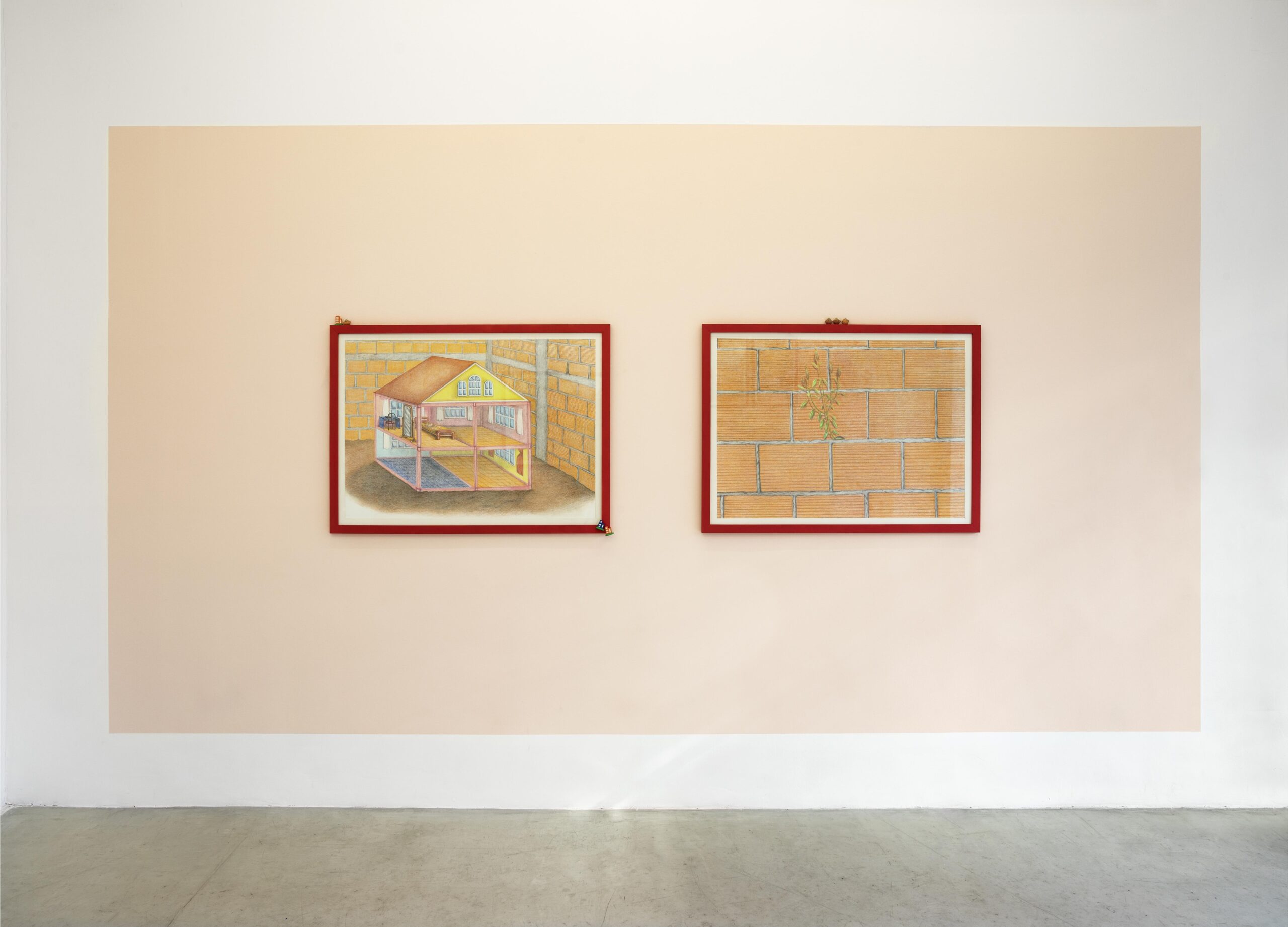
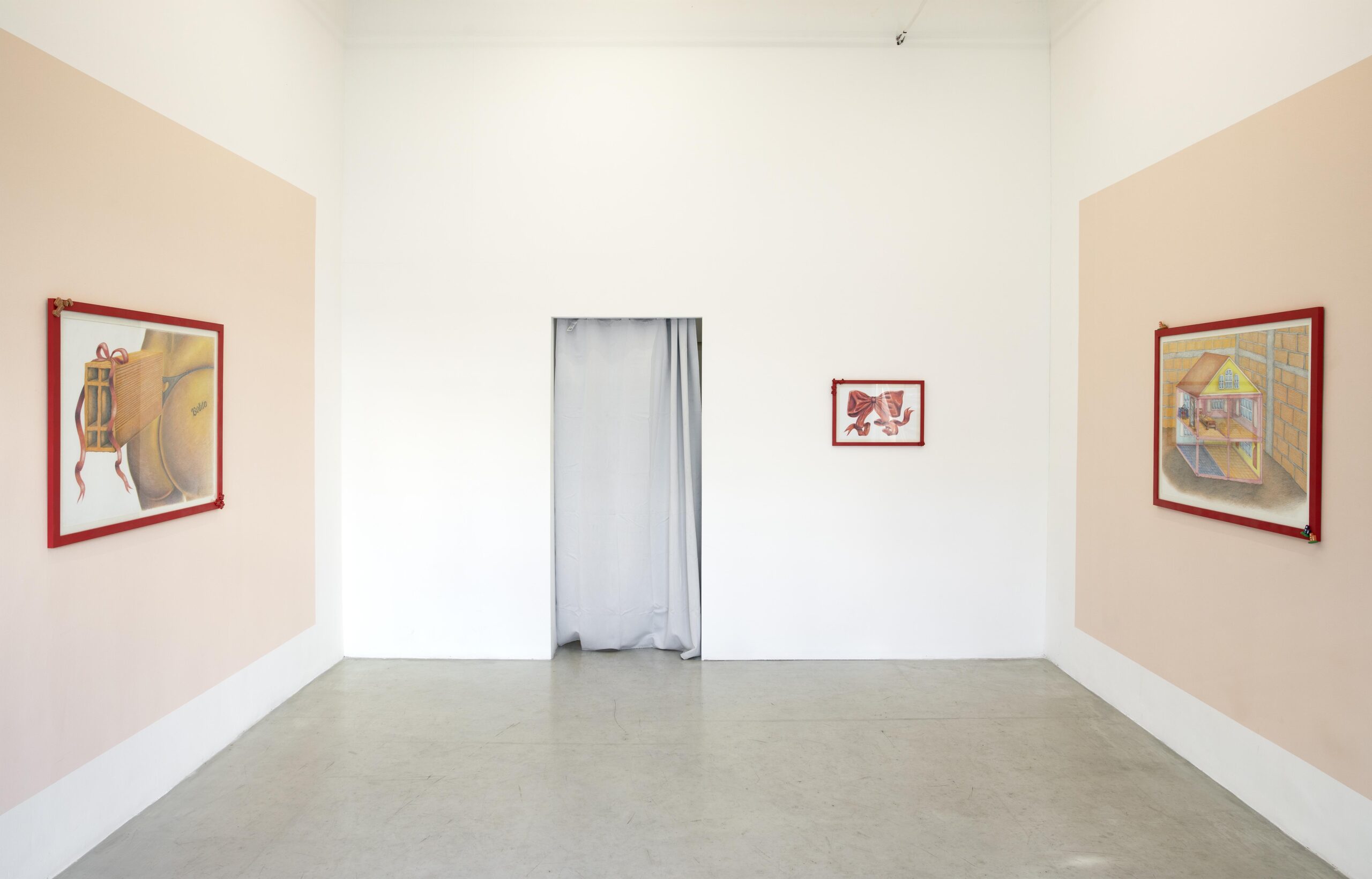
“Home permeates every tendon and every cartilage in my body,” writes Gloria Anzaldúa, as she reflects on the impossibility of meeting the demands of having a single, indivisible identity. She speaks of betrayals—large and small—of borders and divided bodies, of violence both one’s own and that of others, of belonging and the tug-of-war between inside and outside. In the work of Flor Alvarado, the house expands and grows within the body, or perhaps they grow together; it is difficult to tell where one ends and the other begins. Along with them, tensions and conflicts are also amplified.
Her drawings unfold an aesthetic of exuberance and excess: overflowing, sensual bodies; armadillos that, against all odds, grow in the cracks of brick walls; deliberately unfinished constructions that project themselves toward the sky, driven by the sheer will to keep growing. In these images, Flor evokes memories of her childhood and the politics of abundance that emanate from Alasitas and the god Ekeko: the tradition of modeling in miniature the object of desire in order to materialize it. Here, however, tradition and the inscription of belonging to a culture become entangled with ambition, the energy of an unbridled sexuality, and the convergence of desire and right, spilling beyond the norm.
From this encounter—where the multiple identities that inhabit the body strain and blur—emerges a critical resistance. Nestled within her symbols is a set of potentially revolutionary longings, precisely because they are “wrongly” positioned in relation to an increasingly violent status quo. What arises, in opposition to violence, is a soft ontology: a space where the body and the objects that surround it conspire against stereotypes and the paths laid out for them, forging a way forward through a sexy, playful fantasy from which the brick woman is born.
The dollhouse— a fundamental object that knots fantasy to the act of building, designed to operationalize stereotypes and orient desires from childhood—bursts forth with anti-melancholic force to express the search for a spatiality of one’s own. Made of shiny pink plastic, it occupies center stage on the dirt floor of the childhood home, encapsulating not a domesticated aspiration but a disruptive desire. Its reproduction on paper is an affective response to the world, an inversion of the codes of conformity that lays bare the historical trajectories of negotiation in the face of material obstacles and the “distribution of the sensible.”
In Flor’s drawings, the exhibitionism of the body-house lays bare a space for vulnerability—not as a gesture of helplessness in the face of violence, but, on the contrary, as a form of resistance. Her exuberant forms—perhaps excessive for certain dominant modes of expression—free of retouching or filters, display a break with what Rey Chow calls “coercive mimesis,” that mechanism that structures reality for racialized subjects by demanding from them an impossible performance of authenticity: “If it is already difficult for an ethnic person to imitate the white man perfectly, it is even more difficult to imitate oneself,” writes Chow. Faced with this demand, Flor foregrounds the particularities of her way of being in the world and builds, with bows and bricks, a dollhouse tailored to her own subjectivity.